

A cordless paint sprayer turns a weekend of brushing fences, sheds and furniture into a much shorter job, with no cable, compressor or hose to drag around. This guide explains what to look for, which paints work, and how to choose between a cordless HVLP sprayer and an airless machine.
Cordless HVLP or airless?
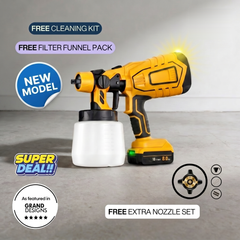
Cordless HVLP (high volume, low pressure) sprayers are handheld, run on an 18V power-tool battery and hold the paint in a pot under the gun. They suit fences, sheds, garden furniture, doors, cabinets and smaller rooms. They put down a soft, controlled spray with less overspray, so they're easier to use around plants, cars and neighbours.
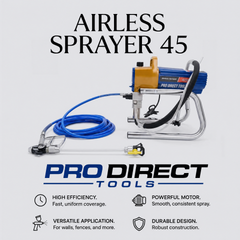
Airless sprayers pump paint straight from the tin through a hose at high pressure. They cover large areas quickly: whole rooms, ceilings, warehouses, barns and long runs of stables. They're mains-powered, need more masking, and take longer to set up and clean. See our airless paint sprayer guide.
As a rule of thumb: if you can finish the job with a few pots of paint, choose cordless HVLP. If you're buying paint in 10-litre tubs, look at airless.
What to look for in a cordless sprayer
- Battery system. Choose a sprayer that runs on the 18V batteries you already own. Ours are made for DeWalt-, Makita- and Milwaukee-compatible 18V batteries, so one set of batteries runs your sprayer, drill and blower.
- Pot size. A 1,000 ml pot means fewer refills on fences and sheds. A spare pot lets you keep a second colour ready.
- Nozzles. Smaller nozzles (around 1.0–1.5 mm) suit thin paints, stains and varnish. Larger nozzles (around 1.8–2.5 mm) suit thicker fence paint and emulsion. A kit with several nozzle sizes covers more jobs.
- Spray patterns. Horizontal, vertical and round patterns let you follow fence boards, then switch for posts and details.
- Flow control. A flow dial lets you turn the paint down for detail work and up for big boards.
- Easy cleaning. Quick-release parts make cleaning faster, and cleaning is what decides whether you'll reach for the sprayer next time.
Which paints can you use?
Cordless HVLP sprayers work well with fence and shed paints, wood stains, water-based paints, varnish and sealers, and thinned emulsion. Always check the tin first:
- Many emulsions need thinning with water for HVLP. Follow the paint maker's advice and use a viscosity cup if one is included.
- Strain paint through a paint strainer as you fill the pot to stop lumps blocking the nozzle.
- Very thick textured coatings and masonry paints are better suited to airless machines.
Tool only or kit?
- Tool only: best if you already have compatible 18V batteries and a charger.
- Kit with batteries and charger: everything ready to go. Two batteries let you spray with one while the other charges.
Every paint sprayer listing shows exactly what's in the box.
How to get a good finish
- Mask anything you don't want painted with pre-taped masking film.
- Test the pattern on cardboard and adjust flow until the edges are soft, not spitting.
- Hold the gun about 20–30 cm from the surface and keep it square, not angled.
- Move your arm, not your wrist, and overlap each pass by about half.
- Two thin coats look better and last longer than one heavy coat.
Cleaning
Clean straight after use. Empty the pot, run clean water (or the right solvent for oil-based products) through the gun, then strip and rinse the nozzle and air cap. A cleaning kit with brushes and picks keeps the small passages clear.
Safety
Wear a mask suited to the product (see our respirators), eye protection and gloves. Spray in a ventilated area, never towards people or animals, and keep pets away from wet paint.
Shop by battery system
- DeWalt-compatible paint sprayers
- Makita-compatible paint sprayers
- Milwaukee-compatible paint sprayers
DeWalt, Makita and Milwaukee are trademarks of their respective owners. Pro Direct Tools is not affiliated with, endorsed by, or authorised by these brands.